
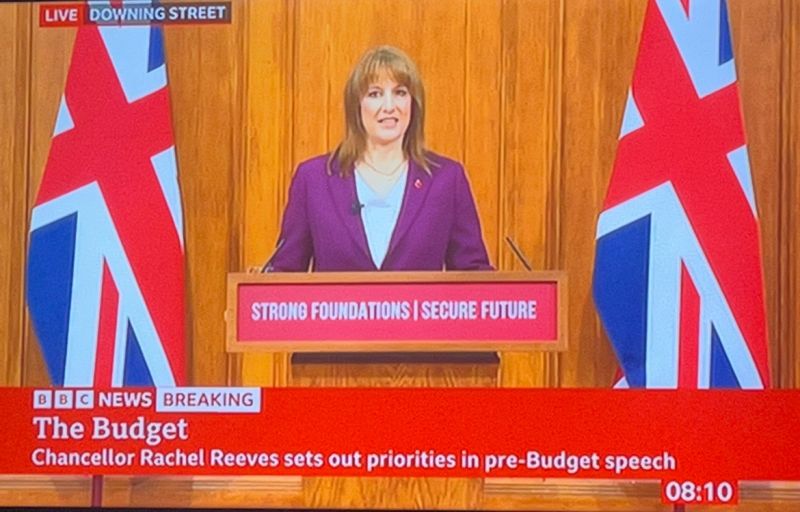
On Tuesday 4 November 2025, Chancellor Rachel Reeves delivered a “scene-setter” speech ahead of the forthcoming Autumn Budget on 26 November. GOV.UK+1 The address laid out the UK’s economic context, the overarching principles guiding policy and some signals of what may be on the way—particularly for the manufacturing sector.
Economic background & fiscal pressures
Reeves made clear that the current fiscal environment is challenging:
- A £62.0 billion fiscal shortfall over the five months to August 2025. Fashion Capital+1
- Public sector net borrowing in the same period stood at £83.8 billion, which includes long-term investments. Fashion Capital
- Public sector net debt is now at 95.3% of GDP as of end-September 2025—a historically high level. GOV.UK+1
Such figures indicate that the Government sees little choice but to manage the books carefully and to consider substantial policy options for revenue and spending. As Reeves put it, the inherited constraints are real and substantial. Sky News
What it means for manufacturing
While the Budget is still three weeks away, several key themes emerged—each of which manufacturers should be tracking closely.
Tax rises & reliefs under pressure
The speech hinted that tax rises may be unavoidable. Industry commentary suggests the Chancellor could target business taxes or scale back reliefs, including capital allowances or R&D credits. Fashion Capital+1
Also, the previous safe-statements (no increase in income tax, national insurance or VAT) appear to be under review. The manufacturing sector should prepare for change.
Investment & the National Wealth Fund
Good news for manufacturing is that the Government retains a focus on investment – including through the existing National Wealth Fund (via the UK Infrastructure Bank) which already supports green manufacturing and traditional heavy industry (for example gigafactories and clean steel).
Manufacturers should watch whether this Fund is expanded or re-targeted in the Budget, especially as the Government talks up “unlocking private investment” in the UK economy.
Business environment & manufacturing competitiveness
Manufacturers currently face headwinds: energy costs remain high, business rates are a burden, and the UK’s wage base is arguably less competitive compared to offshore jurisdictions. The speech acknowledged the need for a level playing field if UK manufacturing is to prosper.
In this context, comments about the “built-in disadvantage” inherited from previous administrations were abundant. Sky News+1
Worklessness, skills and manufacturing jobs
Reeves also referenced broader structural issues: that one in eight young people are currently NEET (not in education, employment or training), and that stability of orders in manufacturing can create long-term job opportunities. For manufacturers, this suggests the Government is thinking about linking manufacturing renewal with labour market reform and skills investment.
What manufacturers should do now
Given the signals from the 4 November speech, here are some practical steps manufacturing businesses should consider:
- Review your tax positioning: With tax reliefs possibly being scaled back, check your entitlement to capital allowances, R&D credits, investment incentives and whether you can accelerate qualifying expenditure.
- Scenario-plan for different Levy outcomes: If business taxes rise, reliefs are reduced or new levies introduced, what does this mean for your pricing, investment and cash flow plans?
- Engage with funding/investment programmes: If your business is seeking to expand, invest in the UK or leverage public-sector procurement, keep an eye on the National Wealth Fund and related schemes. The Government’s emphasis on unlocking investment could create opportunities.
- Benchmark your cost base: Energy, wages and business rates are likely to remain pressure points. Take action to improve cost efficiency, automation and supply chain resilience.
- Prepare for a skills-/labour-dimension: If the Government pursues job-creation via manufacturing, you may see incentives or funding tied to training or employing young people. Consider how this fits your workforce strategy.
- Monitor announcements ahead of 26 November: The pre-budget speech is only a signalling device. The full Autumn Budget will bring concrete measures. Stay alert for changes to tax, reliefs and procurement.
Final thoughts
The Chancellor has painted a clear picture – the UK’s public finances are stretched, and manufacturing sits at a strategic intersection of investment, skills and industrial renewal. For the manufacturing sector, the upcoming Budget is likely to bring both challenges and opportunities. The key will be readiness: acting ahead of time to position for whatever changes are announced on 26 November.