
29 September 2026
As Textile Extended Producer Responsibility (EPR) legislation continues to develop across Europe, multinational fashion and textile brands are facing an increasingly complex regulatory landscape.
With EU member states required to transpose the new rules into national legislation by June 2027 and establish operational schemes by April 2028, businesses operating across multiple European markets will need to prepare for a range of different national reporting and compliance requirements.
A more complex European compliance landscape
Textile EPR is designed to increase producer responsibility for the environmental impact of textiles, encouraging businesses to take greater responsibility for the products they place on the market.
For multinational brands, however, implementation across Europe is likely to create significant administrative and reporting challenges. Different countries are developing their own approaches, meaning businesses operating across borders may need to understand and comply with multiple sets of rules, registration requirements, reporting processes and financial obligations.
This fragmented landscape could make managing textile compliance across several markets increasingly time-consuming and resource-intensive.
Transparency starts with accurate data
For manufacturers and suppliers, the ability to capture accurate production data at source could become increasingly important as EPR and Digital Product Passport requirements develop.
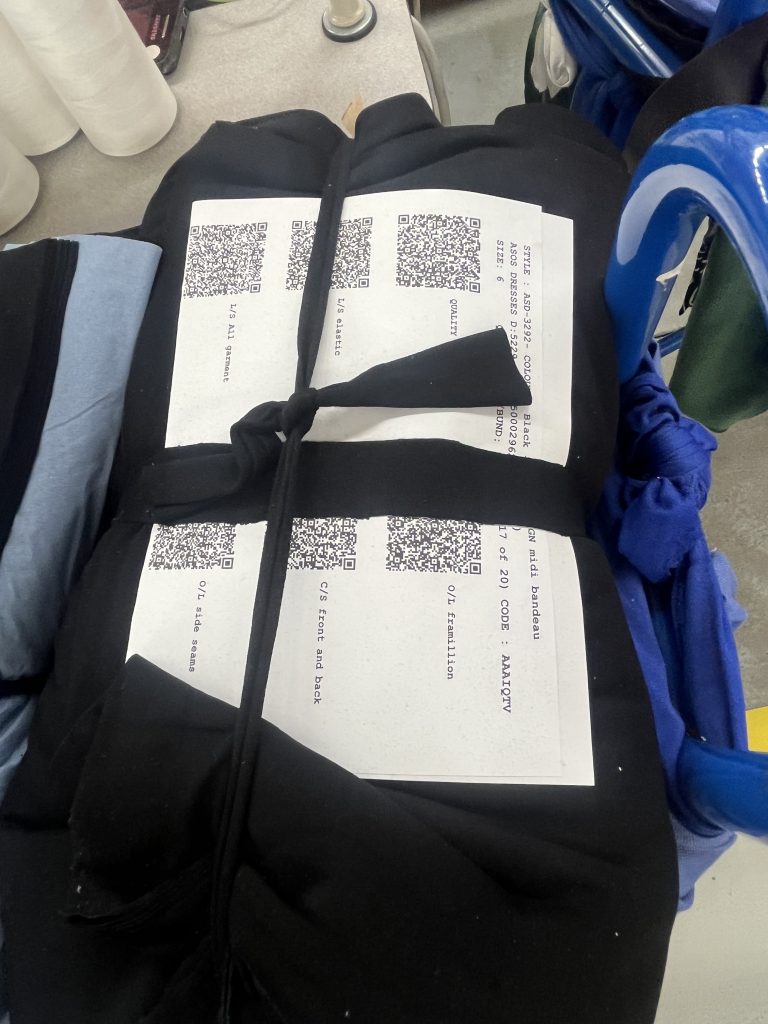
Fashion Enter Limited (FEL) has used Galaxius consistently for more than 10 years, providing detailed visibility of production activity through barcode scanning.
Each machinist scans a barcode when working on a bundle, creating an accurate record of the time taken to complete the work. This provides a transparent record of who has made what and when, while also enabling businesses to understand production and labour data more accurately.
Jenny Holloway, CEO of Fashion Enter Limited, said:
“Over the last 10 years, FEL has consistently used Galaxius. Each machinist scans in a barcode on a bundle, and this gives accurate timing for the work undertaken. There is no hiding; there is only accurate data which shows who has made what and when, and from that you can deduce how much they earn. It’s totally transparent and it stops any form of subcontracting.”
This level of traceability could also provide a foundation for meeting the evolving data requirements associated with EPR and Digital Product Passports.
Holloway believes the existing barcode infrastructure could be expanded to capture additional information, including T4 sourcing data and information relating to recycling and end-of-life management.
“With EPR and the Digital Product Passport, all we need to do is expand the data on the barcode so it includes T4 sourcing and information on recycling/recycling — in other words, the end-of-life product.”
ReDress expands to support multinational brands
To help businesses navigate the growing complexity of Textile EPR, Reverse Logistics Group (RLG) by Reconomy is expanding ReDress, its dedicated Textile Producer Responsibility Organisation (PRO).
Originally launched in Italy in 2024, ReDress combines local market expertise with European-wide support. Its expansion is intended to provide multinational brands with a more coordinated approach to Textile EPR compliance, helping simplify multi-country reporting and reduce administrative complexity.
The approach is supported by RLG’s extensive experience in environmental compliance and Producer Responsibility Organisations. RLG currently manages more than 40 PROs across different EPR categories in 15 countries.
By combining local knowledge, regulatory expertise and data capabilities, the expanded ReDress model aims to help brands manage their obligations as Textile EPR schemes develop across Europe.
Giving brands a voice in Textile EPR development
Alongside its compliance services, RLG by Reconomy has launched a Textile Voice Industry Union, giving brands and retailers an opportunity to contribute to discussions around the practical implementation of future Textile EPR schemes.
A union has recently been established in Poland, bringing together brands including H&M, Zalando, COS and La Mania to engage with discussions around the country’s developing scheme.
Industry participation can help ensure that the practical considerations faced by businesses are represented as national Textile EPR systems take shape.
Greater transparency across the supply chain
While the introduction of new legislation is creating uncertainty for many businesses, Holloway believes greater transparency across textile supply chains should be welcomed.
She said:
“In my humble opinion, I do not understand why there is so much hysteria about the new legislation taking place in Europe. Actually, the UK is so behind the curve it’s almost embarrassing. We need the transparency in our supply chain, and if procurement contracts are going to be awarded to SME companies, then the sooner this legislation is enforced, the better.”
Her comments highlight a broader question for the textile industry: whether new regulatory requirements should be viewed purely as a compliance challenge, or also as an opportunity to improve visibility, accountability and data throughout the supply chain.
For manufacturers, suppliers and brands, the ability to accurately track products from production through to end of life could become an increasingly important part of demonstrating compliance and supporting more circular business models.
Supporting brands beyond compliance
The expansion of ReDress builds on more than 25 years of experience supporting global brands with Textile EPR and related environmental requirements.
RLG’s wider capabilities include:
- Environmental compliance and regulatory monitoring
- Data management and reporting
- Textile take-back schemes
- Digital Product Passports
- Circularity solutions
- Reverse logistics and resource management
Together, these services are designed to help businesses meet their regulatory responsibilities while improving transparency and identifying opportunities to keep products and materials in use for longer.
Preparing for the next stage of Textile EPR
For multinational brands, the development of Textile EPR across Europe means that preparation will become increasingly important.
Businesses will need to understand where they have obligations, how requirements differ between markets and how they can manage reporting and compliance efficiently across multiple countries.
At the same time, manufacturers and supply-chain partners have an opportunity to put the data infrastructure in place to support these requirements. Technologies such as barcode-based production tracking can provide a foundation for greater visibility, with additional product, sourcing and end-of-life information potentially integrated as regulatory requirements evolve.
The combination of accurate production data, supply-chain transparency, EPR compliance and Digital Product Passport information could ultimately provide businesses with a much clearer picture of a product’s journey from manufacture through to end of life.
As Textile EPR continues to roll out across Europe, organisations that invest in transparent, reliable data now can build the foundations needed to navigate the regulatory changes ahead and support a more circular textile industry.