
Twenty UK factories are joining forces to create a stronger voice for small and medium-sized manufacturers seeking opportunities through UK public procurement, with manufacturing, jobs and skills at the centre of the initiative.
Led by the ATMF and Fashion-Enter Ltd, the initiative aims to demonstrate that UK SMEs have the capability, capacity and expertise to deliver Government contracts while helping to retain manufacturing, investment and employment within the UK.
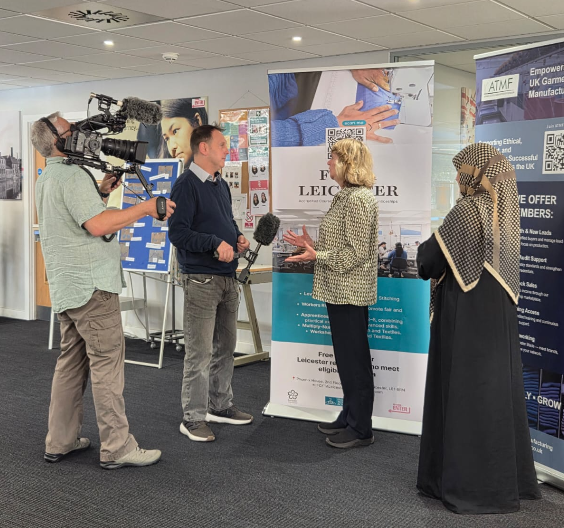
The campaign was recently highlighted by BBC Politics East Midlands, presented by Peter Saull, following a visit to Fashion-Enter’s Fashion Technology Academy (FTA) in Leicester.
Putting UK manufacturing back at the centre
During the BBC visit on 1 October, Dan Martin interviewed Fashion-Enter CEO Jenny Holloway alongside students at the Fashion Technology Academy.
The discussion focused on the future of UK manufacturing and the steps needed to rebuild a stronger domestic industrial base.
For Holloway, one of the most important priorities is the re-industrialisation of the UK. This means creating the right conditions for British factories to grow, invest in equipment and people, create employment and develop the skills required for a sustainable manufacturing sector.
The role of education is equally important. Students at FTA Leicester are gaining practical, industry-focused experience that can provide a direct pathway between training, employment and the manufacturing sector.
Creating greater opportunities through public procurement
The second major focus is the role of public procurement in creating opportunities for UK SMEs.
The Public Procurement Act presents an opportunity to make Government contracting more accessible to capable smaller businesses. However, individual SMEs can often face challenges when competing for large contracts.
The 20-factory initiative aims to address this by demonstrating how smaller manufacturers can work together and present a collective capability to the public sector.
By uniting their expertise and production capacity, the factories can show that UK SMEs are capable of delivering significant Government requirements while maintaining production within the UK.
Why public procurement matters for UK manufacturing
The potential benefits extend beyond winning individual contracts.
Greater participation by UK manufacturers in public procurement could help support factory employment, develop specialist skills and retain economic value within local communities.
For the manufacturing sector, Government procurement can therefore become an important tool in supporting long-term industrial growth rather than simply being a mechanism for purchasing goods and services.
The initiative also highlights the importance of ensuring that procurement opportunities are accessible to businesses with the expertise and capability to deliver, regardless of their size.
Building the next generation of manufacturing talent
The work being undertaken at Fashion Technology Academy Leicester demonstrates that re-industrialisation is about more than factories and production.
A successful UK manufacturing strategy also requires investment in people.
Through practical training and direct exposure to industry, FTA students are developing the skills needed to enter the fashion and manufacturing sectors. Connecting education with industry is essential if the UK is to build a workforce capable of supporting future growth.
The collaboration between manufacturers, education providers and public procurement stakeholders therefore represents a wider vision for the future of British manufacturing.
A stronger collective voice for UK SMEs
With 20 factories already coming together, the initiative is seeking to demonstrate what can be achieved when smaller UK manufacturers collaborate rather than compete individually for opportunities.
The message is clear: UK SMEs have the skills, experience and manufacturing capability to contribute to Government contracts, and they should have a meaningful opportunity to do so.
As the UK looks to strengthen its domestic manufacturing base, public procurement could play an increasingly important role in supporting British factories, creating jobs, developing skills and keeping economic value within the country.
The BBC Politics East Midlands coverage has helped bring this conversation to a wider audience, highlighting the need for a joined-up approach to manufacturing, skills and public procurement.
The 20-factory initiative is now putting that vision into practice by giving UK manufacturers a stronger, unified voice and demonstrating the capability of British SMEs.